

By: Milana Abdyrakmanova. New Media and Communication Science Faculty
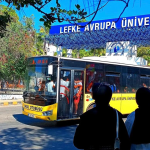
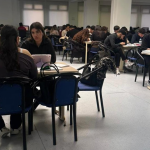
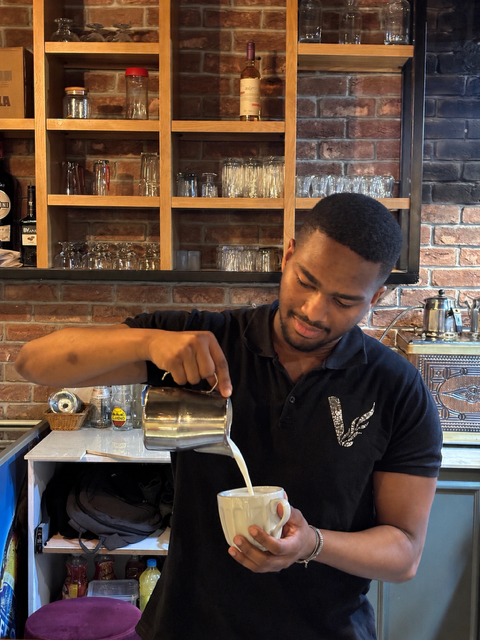
Walk through Lefke on any given evening and you will probably run into a fellow student behind a counter somewhere. At European University of Lefke, working alongside studying is pretty common, not something unusual, just something a lot of people here do.
The Shift Before the Lecture
The town’s cafés, restaurants, and shops rely heavily on student workers. Waiters, cashiers, delivery drivers, cleaners, sales assistants — students fill most of these roles, both in Lefke-Gemikonaği and in nearby areas. Shifts at many places go until 2 a.m., and for delivery workers at spots like Raccoon and Inovips, the night can stretch to 5 a.m. before classes start again in the morning.
Alua Saparkhan, a Business and Administration student, knows this routine well. She works evening shifts at a local restaurant, finishing at 2 a.m., sometimes later with a 9 a.m. class waiting on the other side.
“My work starts at 8 and finishes at 2 a.m. I have morning class at 9 twice a week and honestly it is difficult to wake up, but I try not to miss lessons,” she says.
Alua started working by choice, not out of financial pressure. “I wanted to earn my own money to cover basic expenses,” she explains. “My parents don’t make me work, this is my personal choice.” Even so, she takes as many hours as she can get, simply because she enjoys the environment.
Her colleague at the same restaurant, Nurlan Nurmukhamed, a preparatory school student, has a more flexible schedule. His first class starts at 2 p.m. He says work has not affected his studies or energy in any noticeable way. For him, like for Alua, it was a personal decision to start working, and rising prices have not changed how much he works.
The reasons are not complicated for most. Living costs have gone up noticeably over the past couple of years, prices for food, transport, and everyday basics have all increased, and student budgets have felt it. Many work to cover their own expenses, help out their families, or simply keep up with a cost of living that has gotten harder to manage on a student allowance alone.
Turkish Practice At Workplace
Since Northern Cyprus operates mostly in Turkish, some customer-facing roles naturally work better for those who already speak the language, which can occasionally limit options for international students, especially early on.
However, many local employers are open to hiring international students regardless, and the workplace often turns out to be one of the better places to pick up Turkish. Learning through daily interactions with colleagues and customers tends to stick in a way that classroom lessons do not always manage.
In-Campus Employment
Some students work without ever leaving campus. The university employs students across several departments — in the library, the cafeteria, and the international office, where tasks can include handling paperwork and supporting day-to-day operations. Older students often take on coordinating roles: welcoming new arrivals, showing them around campus, travelling to other cities for university events, and helping students get settled from the moment they land. At the start of the academic year, that means airport pickups in the middle of summer heat, back-to-back orientations, and long days that do not leave much room for anything else.
EUL Social, the university’s official Instagram account, runs on the same energy, and is entirely student-operated. Saad Ait-Hammou, a Software Engineering student and member of the EUL Social team, describes the job as a constant balancing act.
“The hardest part is giving enough time for both my studies and finding ideas for my videos,” he says. The pressure peaks when events overlap. “There were moments when I had to be in multiple places at the same time” — a situation that anyone who has juggled shoots, deadlines, and exams at once will recognize immediately.
Still, when asked if he would do it again, his answer is straightforward: “Yes, of course.”
From Teacher’s Perspective
The people standing at the front of the classroom are often aware of what is happening behind the scenes. Zühre Özer, a lecturer in the Communication and Design Faculty, says she picks up on it without students having to say anything.
“I usually notice through their body language, participation level, and focus,” she says. Her response is to adapt where she can. “I try to be understanding, give flexibility if possible, and offer support or guidance.”
On the broader question of whether working helps or hurts, she sees both sides clearly: “It can help with responsibility and experience, but too much work can negatively affect academic performance.”
It is a balance that most working students are trying to find in real time.
Positive Side
A lot of students do not see their jobs purely as a burden. Working builds real habits, time management, handling money, dealing with people, things that are difficult to learn from classes alone. For students far from home, having their own income also brings a level of independence that matters in a way that is hard to explain until you have it.
Keeping Up
The mix of rising prices, part-time jobs, academic deadlines, and life far from home is a lot to carry. Most students at EUL are managing it anyway, not dramatically, just quietly, day by day. Some nights run late. Some mornings start too early. But the work gets done, the classes get attended, and somehow the balance holds, most of the time.