


By: Arsema Wegayehu Hailu
The New Academic Frontier
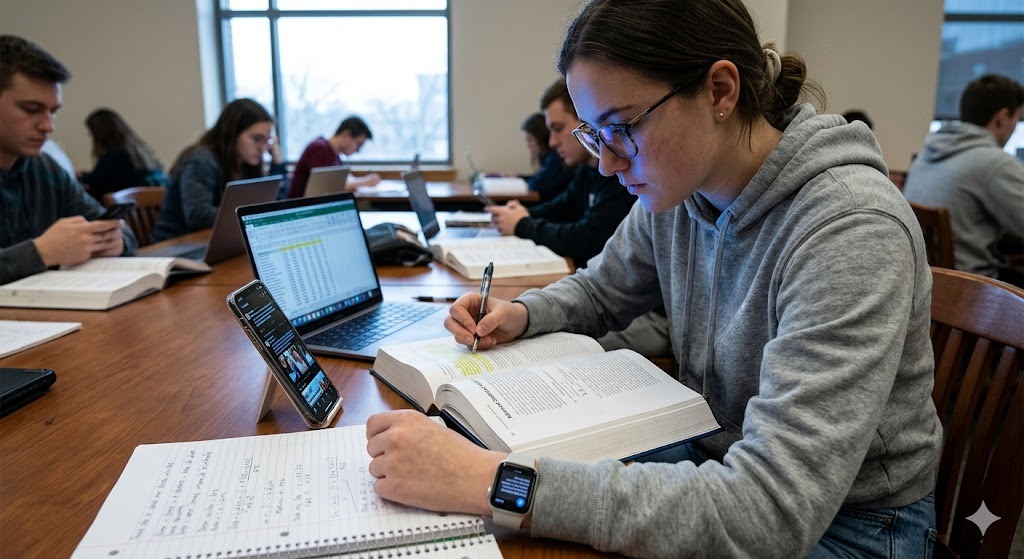
In the spring of 2026, a silent transformation has taken place within the walls of the modern classroom. The traditional image of a student hunched over a heavy paper textbook is being replaced by the blue light of a smartphone. While educators and parents have long feared that social media acts as a primary distraction to learning, a recent investigative study of 11 students suggests a much more complex reality. This research reveals that the “scroll” is no longer just for entertainment it has become a vital, albeit distracting, pillar of academic survival.
The investigation, conducted through a comprehensive data-analysis project, sought to uncover the “Who, What, Where, When, Why, and How” of modern student life. The findings paint a picture of a generation that is constantly connected, highly self-aware, and surprisingly successful in balancing a high-tier GPA with extreme levels of screen time.
The most immediate takeaway from the research is that “unplugging” is a thing of the past. The survey indicates that 100% of the student body interacts with social media on a daily basis. Specifically, 54.5% of respondents log on every single day, while a significant 45.5% check their platforms multiple times throughout the day. This creates a 24/7 digital environment where the boundaries between “personal time” and “study time” are almost entirely erased.
When we measure the sheer volume of time spent, the numbers cross into what many would consider “high-risk” territory for academic neglect. According to the data, 36.4% of students are spending more than five hours every day on social media. Another 36.4% spend between three and five hours. In total, nearly 73% of the student population is spending a minimum of 21 hours per week on digital platforms the equivalent of a part-time job.
Perhaps the most shocking revelation of the 2026 data is the lack of a “grade collapse.” Traditionally, high screen time was equated with poor performance. However, this study discovered what can only be described as a “GPA Paradox.” Despite the majority of students spending 3 to 5+ hours online daily, academic standards remain remarkably high.
The breakdown of student performance shows a resilient academic culture: 30% of students maintain a GPA in the highest tier of 3.5–4.0.
40% of students hold a strong 3.0–3.49 average.
30% remain competitive with a 2.5–2.99 GPA.
With 0% of students reporting a GPA below 2.0, the evidence suggests that students are not “wasting” their time in the traditional sense. Instead, they are evolving their study habits to coexist with their digital lives.
To understand how students maintain high grades while staying online for five hours a day, we must look at the nature of their activity. The research clarifies that social media has transitioned from a “social” space to a “resource” space. While 81.8% of students still use these platforms for entertainment, an identical 81.8% are now utilizing them for direct academic support.
Students are effectively “outsourcing” their learning to digital creators. 81.8% of respondents reported watching educational videos as a primary study method. This is supplemented by a high level of peer-to-peer collaboration: 72.7%use social media to share notes and materials, and another 72.7% use it to ask classmates questions in real-time. This “always-on” study group means that help is never more than a message away, which may be the secret behind the stable GPAs reported across the board.
The perception of social media among the youth has shifted from a “guilty pleasure” to a “necessary tool.” When asked if there is a positive side to social media in education, the response was overwhelming. Over 81% of the participants agreed or strongly agreed that these platforms are beneficial to their learning journey.
This positive sentiment is rooted in the “How” of their daily routines. Students no longer view YouTube, TikTok, or Instagram as purely recreational. They view them as massive, decentralized libraries where complex topics can be explained in 60-second clips that are often easier to digest than a traditional lecture. However, this convenience comes with a secondary cost: the erosion of deep, uninterrupted focus.
While the “positive side” is undeniable, the research also highlights a growing crisis in student concentration. The study looked closely at “The Multitasking Trap” the habit of switching between academic work and digital notifications. The results show that total focus is becoming a rarity in the modern study hall.
A combined 100% of students admit to checking social media while they are actively trying to study. Specifically, 63.6%do so “occasionally,” while 54.5% admit it happens “sometimes.” No student in the survey reported the ability to “Never” check their phone during a study session. This constant interruption is where the academic performance feels the most friction. In the open ended portion of the research, students expressed a deep awareness of this struggle. One respondent noted that social media usage “takes away your time that could be used for studying,” while another admitted to “scrolling a lot for memes” even when they should be focused on research.
When students were asked to reflect on their own performance, the community was split. 45.5% of students were neutral, believing they have mastered the balance. However, an equal 45.5% agreed or strongly agreed that their academic performance is being hindered by the sheer amount of time they spend on these apps.
This data suggests a “high-functioning distraction.” Students are doing well enough to keep their GPAs above 3.0, but there is a lingering sense that they could achieve even more if they could break the five-hour-a-day habit. The “Why” behind their usage is a mix of necessity and compulsion; they need the apps to study, but they stay for the entertainment.
Conclusion: Navigating the 2026 Academic Landscape
The findings of this investigative feature conclude that the debate is no longer about whether students should use social media, but rather how they can use it without losing their focus. The “5Ws and 1H” of this research reveal a student body that is:
WHO: Academically ambitious but digitally dependent.
WHAT: Using social media as a dual-purpose tool for entertainment and research. WHERE: Studying in a fragmented digital-physical environment.
WHEN: Connected 24/7, even during active study hours.
WHY: To seek out faster, more collaborative ways to learn.
HOW: By sacrificing deep concentration for the sake of instant information and note-sharing.
As we look toward the future of education, it is clear that the “Study or Scroll” choice is a false one. For the 2026 student, studying and scrolling are intertwined. The challenge for the modern reporter and educator alike is to help students navigate this digital double-edged sword ensuring
that the five hours spent online contribute more to the 4.0 GPA than to the “meme-scrolling” that threatens to take it away.
Methodology Note: This report was compiled from a Google Forms research project targeting 11 active students. All data points were cross-referenced against reported GPA averages and usage frequencies to ensure an accurate representation of the current academic climate.
By: Arsema Wegayehu Hailu
May 14, 2026
-THE END